

A mother was driving her three young sons home from picking up Christmas decorations. She was approaching the intersection of Highway 316 and Jackson Trail Road in Barrow County. The stop sign that should have warned her she was approaching an intersection was gone. She didn’t stop, and her car was struck by another vehicle. The wreck killed her and her 1-year-old son and seriously injured her other two children. We secured a $2,500,000 settlement with the Georgia Department of Transportation (GDOT).
Case Summary
- Settlement: $2,500,000
- Location: Intersection of Highway 316 and Jackson Trail Road, Barrow County, Georgia
- Type of Case: Road defect / unsafe and dangerous road case against GDOT for fatal car accident caused by a missing stop sign
- Injuries: Two deaths (a mother and her 1-year-old son); a traumatic brain injury with permanent cognitive impairment (4-year-old); a femur fracture requiring two surgeries (6-year-old)
- Liability Issue: Whether GDOT negligently designed, inspected, and maintained the intersection
- Result: Settled at mediation for $2,500,000
What Happened
On November 11, 2022, a mother left her home in Jefferson, Georgia to do a “porch pick up” of Christmas decorations from a house in Bethlehem, off Highway 316. She had her three young sons with her — ages 6, 4, and 1. She wasn’t familiar with the area, so she was following GPS directions home.
On the way home, her GPS routed her down Jackson Trail Road. At the intersection with Highway 316, the stop sign was missing. Because there was nothing to warn her she was approaching a highway, she didn’t stop. She entered Highway 316 and her car was struck by another vehicle.
A Georgia State Patrol trooper had driven through that same intersection roughly 40 minutes before the wreck. His dashcam captured the missing stop sign, but he didn’t notice it was gone. A picture from the trooper’s dashcam is below:
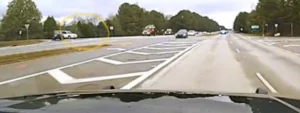
If anyone — GDOT, law enforcement, or another driver — had reported it in that 40-minute window, the sign could have been replaced before the wreck. GDOT’s own records showed that when stop sign knockdowns were reported, its crews had fixed this exact sign in as little as 30 minutes.
The Injuries
The wreck killed the mother and her 1-year-old son.
Her 4-year-old suffered a traumatic brain injury, spent a week and a half in a coma, and required a breathing and feeding tube to survive. He has permanent cognitive impairment as a result.
Her 6-year-old suffered a broken femur that required surgery and a second surgery to remove the surgical hardware.
Evidence Showed Driver Wasn’t Speeding or Distracted
We knew one of the issues in this case would be whether the mother was partially at fault for not recognizing she was approaching an intersection, even if the stop sign was missing. Given that, we wanted to prove that she was driving carefully and not distracted.
We used the data from her car’s Airbag Control Module to show she was driving under the 55 mph speed limit in the seconds before the crash. We retained a cell phone forensics expert to forensically search her cell phone to see whether she was using her phone leading up to the crash. The data from her phone showed she was not using it, only that she had Apple Maps open for directions. Even GDOT’s own accident reconstruction expert admitted in his deposition that he had no evidence she was speeding or distracted.
The Challenge: GDOT Had Just Replaced the Sign
The wreck happened on a Friday. The biggest challenge in this case was that GDOT’s work orders showed the stop sign had been replaced the Monday before the wreck. In the four days between that replacement and the crash, there was no report of the sign being knocked down, damaged, or going missing again.
That gave GDOT a straightforward defense: it had just fixed the sign days earlier, no one had reported a problem since, and it had no way of knowing the sign was gone again before this wreck.
Given this, we weren’t going to be able to prove that GDOT had actual notice that this sign was down on the day of the wreck. So we began investigating the intersection’s design and whether GDOT was appropriately inspecting and maintaining the intersection.
GDOT Records Showed the Stop Sign Had Been Replaced at Least 12 Times
We sent Open Records Requests and discovery requests to GDOT for work orders at this intersection. They showed this stop sign had been replaced at least twelve times in the years before and after the wreck. While the work orders didn’t always specify why the sign was replaced, it was usually due to damage from cars hitting it. GDOT’s employee responsible for inspecting and replacing signs testified in his deposition that this intersection had a higher-than-usual number of knockdowns.
How We Proved GDOT Was Responsible
Here’s how we proved the case:
The Stop Sign Was Too Close to the Highway
We retained the former dean of the Engineering Department at Vanderbilt University to evaluate the intersection’s design. He inspected the intersection and found that the stop sign sat only 7.75 feet from the edge of the travel lane.

The Manual on Uniform Traffic Control Devices (MUTCD) is published by the federal government and contains national standards for installing and maintaining traffic control devices like stop signs. The MUTCD requires that in situations like this stop signs be placed at least 12 feet away from the travel lane – specifically so a car that loses control is less likely to strike the sign.
Our engineering expert testified that this placement didn’t meet industry standards and made the sign more likely to get knocked down.
The Stop Sign Should Have Been In Raised Concrete Island
The expert also testified that the sign should have been in a raised concrete island with reflective chevron markings instead of a painted island, which would have made the island more visible to approaching drivers and less likely to be knocked down.
The “Stop Ahead” Warning Had Faded Away
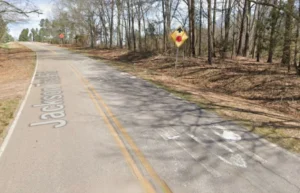
Historical Google Street View images showed that the “Stop Ahead” pavement marking near the intersection — meant to warn drivers they were approaching an intersection— had faded to the point of being illegible by the time of the wreck:
GDOT Did Not Properly Inspect the Intersection
GDOT had an unwritten practice of “riding the routes” on a weekly basis to check for missing or damaged signs. When GDOT employees conducted those inspections, they were supposed to fill out a work order to prove they’d done so. But GDOT had no documentation showing anyone had inspected Highway 316 for months before the wreck. And the GDOT foreman responsible for those inspections testified in his deposition that he didn’t know the last time he conducted an inspection.
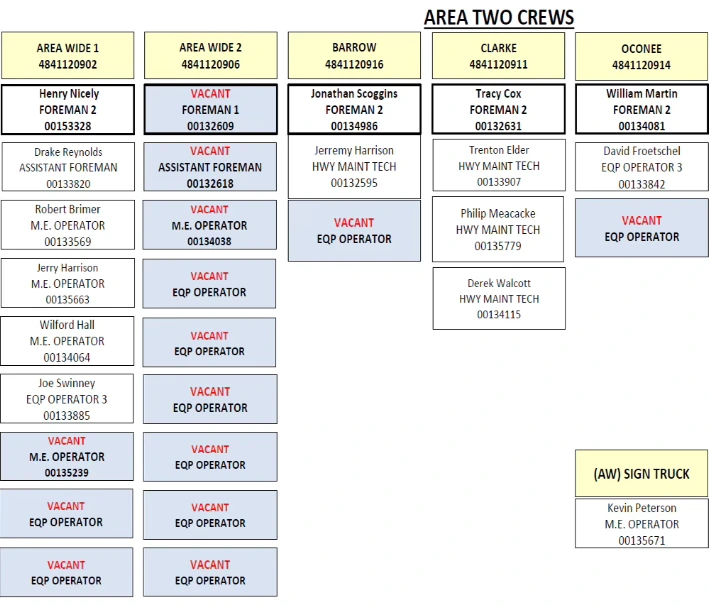
We also discovered evidence that GDOT was short-staffed and that employees were on vacation for a state holiday the day of and the day before the wreck. A GDOT organizational chart showing vacant positions is below. We argued that the staffing shortages and vacation contributed to GDOT not properly inspecting the intersection the week of the wreck.
How The Georgia Tort Claims Act Limited the Recovery
Claims against a state agency like GDOT don’t work like an ordinary car accident case. The Georgia Tort Claims Act requires a specific “ante litem” notice to the state within a year of the incident. If you miss the deadline, your claim will be barred no matter how strong the underlying case is or how badly you were injured.
The GTCA also includes a “cap” on the total amount that can be recovered in a lawsuit, which is $1,000,000 per person / $3,000,000 per accident. This cap applies no matter how many people were hurt or killed or how severe the injuries are. Even if you go to trial and get a verdict for more than that, state law requires the verdict be reduced to the $1,000,000 / $3,000,000 damages cap.
This case involved four separate claims — two wrongful death claims and two injury claims on behalf of the surviving children. Therefore, the most that was available for one of the claims was $1,000,000, and the most that was available to cover the entire accident was $3,000,000.
In a case against an insurance company, if the insurance company refuses an offer to settle the case and a jury returns a verdict for more, the insurance company can be held responsible for the entire amount of the verdict. That often creates pressure on insurance companies to settle cases. However, that doesn’t apply to the State due to the damages cap. No matter how large the verdict, state law still requires the verdict be reduced to the $1,000,000 / $3,000,000 damages cap.
Given that, the State does not feel much pressure to settle cases because it knows its worst day in court is set by the damages cap.
Why The Case Settled for $2.5 Million
Before the case went to trial, we mediated the case and reached a $2,500,000 settlement.
Given that we had a real dispute over the State’s liability, the $2,500,000 settlement reflects the practical reality of the case. If we went to trial and won we would get a much higher verdict, but it would be reduced to $3,000,000. If we went to trial and lost, the family would get $0.
Key Takeaways
- A missing sign alone doesn’t win a case against the state. You have to prove GDOT knew or should have known, through design, maintenance, or inspection failures.
- GDOT’s own records helped win the case. Years of GDOT work orders showing the stop sign was repeatedly knocked down helped prove that the intersection was negligently designed.
- Employee depositions were crucial. Testimony from the foreman who couldn’t remember his last inspection, and the sign truck operator who confirmed the unusually high number of stop sign knockdowns, were very important to securing this settlement.
Injured in a Car Accident Caused by a Dangerous or Unsafe Road?
If you or a loved one has been hurt because of a dangerous road condition, a missing or obscured traffic sign, or a poorly designed intersection, contact us for a free consultation. Claims against government agencies like GDOT involve strict deadlines and legal hurdles that don’t apply to ordinary car accident cases, so it’s important to act quickly. No fee unless we win.
FAQ
What is the Georgia Tort Claims Act, and how is it different from suing a private driver?
The Georgia Tort Claims Act is the law that allows people to sue state agencies like GDOT for negligence, but it comes with rules that don’t apply to a normal car accident claim — including mandatory notice requirements and a cap on how much can be recovered per occurrence, regardless of how many people were injured or killed.
What is an ante litem notice, and what happens if I miss the deadline?
An ante litem notice is a formal notice that must be sent to the state within 12 months of an incident. It must include information on the responsible state agency, the location, date, time, how the state agency was negligent, your injuries and damages and a specific settlement amount. If it isn’t sent correctly or on time, the claim will be barred entirely, even if the underlying case is strong.
Can you sue GDOT for a missing or damaged road sign?
Yes, but it requires showing GDOT knew or should have known about the problem — through evidence of design defects, inadequate maintenance, or a failure to follow its own inspection practices — not just that a sign happened to be missing at the time of a wreck.
Does the Tort Claims Act cap limit what I can recover even if my damages are higher?
Yes. The Georgia Tort Claims Act includes a cap of $1,000,000 per person / $3,000,000 per accident. This means that the most one person can recover is $1,000,000 and the most that can be recovered when multiple people are injured or killed is $3,000,000. There are no exceptions and the cap applies no matter how many people are injured or killed or how much their combined losses total.
