

A Dublin man suffered serious leg and internal injuries after another driver pulled out in front of him on Highway 29 in Laurens County, Georgia, causing a collision he could not avoid.
We secured a $355,000 settlement for him before trial—despite the case being filed in Laurens County, a venue not known for large verdicts or settlements.
Case Summary
- Settlement: $355,000
- Location: Highway 29 / Laurens County, Georgia
- Type of Case: Car accident – failure to yield
- Injuries: Leg crush injury, kidney laceration, long-term mobility limitations
- Insurance Challenge: At-fault driver had only minimum coverage; multiple people were seriously injured in the wreck
- Strategy: Stacked multiple uninsured motorist (UM) policies totaling over $1,000,000 in available coverage
- Additional Result: Eliminated workers’ compensation subrogation lien, preserving the client’s recovery
The Accident
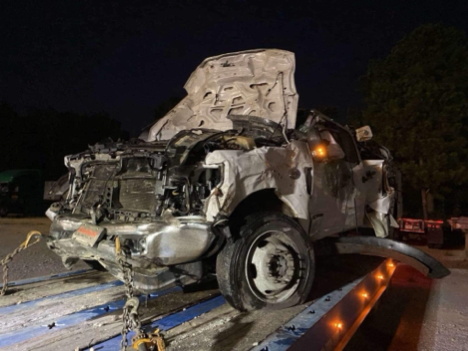
Our client was driving on Highway 29 in Laurens County outside Dublin, Georgia. He had two coworkers in the car with him and they were driving to a job site. A driver pulled out in front of him from a side road. He tried to stop but couldn’t and crashed into the other driver’s car. Here’s a picture of his truck after the wreck:
Injuries & Medical Treatment
Mr. E suffered serious injuries in the crash and had to be extricated from his vehicle using the Jaws of Life—a process that took over an hour.
His injuries and treatment included:
- Leg crush injury: Left leg trapped in the wreckage, causing severe bruising, swelling, and inability to bear weight
- Kidney laceration: Internal organ injury confirmed by CT scan
- Dystrophic calcification in the leg: Post-traumatic condition affecting strength, mobility, and range of motion
- Multiple soft tissue injuries: Significant bruising throughout the body
Medical care and recovery:
- Emergency transport to Fairview Park Hospital in Dublin, Georgia
- CT scans and MRIs to evaluate internal and orthopedic injuries
- More than 6 months of physical therapy
- Ongoing difficulty with walking, balance, stairs, and standing
- Increased fall risk requiring use of a cane or walker
Before the crash, Mr. E was active and independent. His injuries forced him to retire and have left him with lasting mobility limitations that affect his daily life.
Minimal Insurance Coverage Complicates Case
The other driver had state minimum limits, which are $25,000 per person / $50,000 per accident. Our client did not retain us until months after the accident and by this time his insurance company had already paid this out to the other people injured in the wreck.
How We Maximized Our Client’s Recovery
This case required identifying multiple insurance policies, resolving competing claims, and eliminating reimbursement claims to maximize our client’s recovery.
Stacking Uninsured Motorist Coverage
Because the other driver’s insurance policy was paid out, we had to look to uninsured motorist coverage to secure a settlement for our client. There were two uninsured motorist coverage policies that covered this accident:
- $25,000 in uninsured motorist coverage on our client’s automobile policy
- $1,000,000 in uninsured motorist coverage through his employer’s automobile policy
Georgia law allows you to make a claim of your uninsured motorist coverage even if you’re not in your car at the time of the accident, like this situation.
These two policies stacked on top of each other for a total of $1,025,000 in uninsured motorist coverage.
Our client’s uninsured motorist coverage agreed to pay him the $25,000 in coverage.
However, our client’s two co-workers were also badly injured in the accident and also made a claim against the $1,000,000 in uninsured motorist coverage available through their employer’s policy. We mediated the case and agreed on how much each person would receive from the policy, with our client receiving $330,000 in uninsured motorist coverage, making for a total settlement of $355,000.
Eliminating Worker’s Compensation Subrogation Lien
Because our client was working at the time of the wreck, he had both a worker’s compensation claim and a personal injury claim against the other driver that caused the accident. Worker’s compensation paid all of our client’s medical bills but then sought repayment through a process called subrogation. Under Georgia law O.C.G.A. 34-9-11.1(b), worker’s compensation is only required to be repaid “if the injured employee has been fully and completely compensated” for their injuries from the personal injury case. We argued that there were multiple people injured in this wreck and that there was insufficient insurance coverage for their injuries. Worker’s compensation dropped its repayment claim.
Injured in a Car Accident in Dublin or Laurens County?
If you were injured in a crash that wasn’t your fault, liability may be clear—but the value of your case depends on the injuries, available insurance, and how the claim is handled.
Cases like this one often involve multiple insurance policies and competing claims. Understanding how those pieces fit together can make a significant difference in the outcome of your case. If you were hurt in a similar crash, talk to a car wreck lawyer in Athens about your options.
Frequently Asked Questions
What if the at-fault driver doesn’t have enough insurance?
You may still recover through uninsured or underinsured motorist coverage, as in this case.
Can I make a UM claim if I wasn’t in my own car at the time of the accident?
Yes. In Georgia, uninsured motorist coverage may apply even if you were not in your vehicle at the time of the crash. Your uninsured motorist coverage usually applies if you are driving or riding in someone else’s car, riding a bicycle or as a pedestrian.
Can I have both a workers’ compensation and personal injury claim?
Yes. If you were working at the time of the crash, you have both a worker’s compensation claim against your employer and a personal injury claim against the at-fault driver.
