

An 84-year-old senior citizen suffered life-changing injuries after tripping over a curled and rippled entrance mat at a local business in Athens, Georgia. She broke her femur and injured her neck, requiring two surgeries. Her injuries stripped her of her independence, forcing her to move into a senior living facility.
The insurance company initially denied responsibility, claiming the rippled mat was “open and obvious” and that our client was to blame. Our Athens personal injury lawyers then filed a lawsuit, secured admissions from the owner of the company and management that proved the business negligent and won a $950,000 settlement.
Case Summary
- Location: Athens-Clarke County, Georgia
- Type of Case: Slip and fall / trip and fall (premises liability)
- Hazard: Curled and rippled entrance mat
- Injuries: Broken femur and neck injury requiring surgery
- Insurance Position: Denied responsibility / blamed the client
- Resolution: $950,000 settlement
What Caused the Fall
Our client and her cousin were visiting a local business. There was an entrance mat inside the front door and its edges were curled and rippled. As they walked in, our client’s foot caught one of the curls and she tripped and fell, breaking her leg and injuring her neck. A picture of the mat taken after the fall is below. Note that the mat has been flipped around so the edge with the curl / ripple is opposite the door:
Georgia Premises Liability Law and Proving Constructive Knowledge
Georgia slip and fall cases often turn on whether the property owner knew or should have known about the hazard before someone got hurt.
Under Georgia law, an injured customer generally must show:
- The business had actual or constructive knowledge of the dangerous condition; and
- The injured person lacked knowledge of the hazard despite exercising ordinary care.
Johnson v. LT Energy, LLC, 368 Ga. App. 439 (2023).
Simply put, this means you have to prove the business knew about the hazard and you didn’t.
What Is “Actual Knowledge”?
Actual knowledge is when an employee sees a hazard or a customer reports it to the business.
What Is “Constructive Knowledge”?
Constructive knowledge is when a business should have known about the hazard.
Georgia courts recognize two ways to prove constructive knowledge:
- An employee was in the area of the hazard and could have seen it and cleaned it up; or
- The hazard was there long enough that the business should have noticed it and removed it
Benefield v. Tominich, 308 Ga. App. 605 (2011).
How We Proved Constructive Knowledge
We developed evidence and testimony that the mat was visible from the hostess stand, that employees repeatedly walked by the mat during the day, that managers were required to inspect the store for hazards several times per day and that the mat had been in place for several days. This was strong proof of constructive knowledge.
We took the deposition of the owner of the company about the fall and he testified as follows:
Q. Do you agree that floor mats that ripple or curl or have torn edges are trip hazards?
- Yes.
Q. Do you agree that when a mat ripples or it has curls or torn edges, the mat should be removed from service?
A. Yes.
Q. And do you agree that when a mat ripples or curls or has torn edges, the mat should be replaced with a mat that lies flat?
A. Yes.
Catastrophic Injuries After the Fall
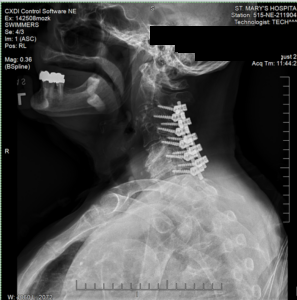
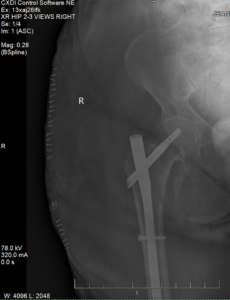
EMS rushed our client to the emergency room at St. Mary’s Hospital. Doctors ordered X-rays, which showed a major fracture of her femur near the hip, and an MRI of her neck showed a severe spinal cord compression:
She underwent multiple major procedures, including:
- Surgical repair of the femur with an intramedullary rod and screws
- Cervical spine decompression and fusion surgery
- Extended hospitalization
- Skilled nursing and rehabilitation care
- Ongoing physical and occupational therapy
How the Injuries Changed Her Life
Before the fall, our client lived independently, maintained her home, gardened, drove herself around Athens, and attended church weekly. After the injuries, she required long-term assisted living care and now relies on a wheelchair for mobility.
The fall stripped our client of the ability to:
- Walk independently
- Live in her own home
- Perform basic daily activities, such as cooking and cleaning
- Attend church
- Travel without assistance
- Participate in family gatherings
She continues to suffer chronic pain, numbness in her extremities, sleep disruption, and emotional distress from losing her independence.
The $950,000 Settlement
After the insurance company denied the claim, we filed a lawsuit in Athens-Clarke County State Court. We took the depositions of multiple employees, managers and the owner of the business. Before the case went to trial, the defense offered a $950,000 settlement, which our client chose to accept.
Injured in a Slip and Fall in Athens, Georgia?
If you or a loved one was hurt in a slip and fall or trip and fall accident in Athens, contact us for a free consultation about your case. There is no fee unless we win.
FAQ
What if the insurance company says the hazard was “open and obvious”?
Georgia law says it is usually up to the jury to decide whether a hazard was “open and obvious.” If the insurance company denies your claim on that basis, it means you’re going to need to file a lawsuit and develop evidence proving the business responsible.
How do you prove a business knew about a slip or trip hazard?
In Georgia slip and fall / trip and fall cases, a business can be held responsible if it had actual or constructive knowledge of a dangerous condition. That can include evidence employees saw the hazard, customers reported it, employees walked by it and could have seen it or that the business did not have a reasonable inspection routine in place.
What does it mean if the insurance company denies my slip and fall claim?
When an insurance company denies a slip and fall claim, it means the insurance company is not going to voluntarily settle your case at that stage. You’re going to need to retain an attorney, file a lawsuit and obtain evidence and testimony that shows the business was negligent. If you do so, the insurance company may re-evaluate its position. It’s common for insurance companies to deny claims that later settle – even for very significant amounts – before trial.
